Middle Tennessee State University Athletics
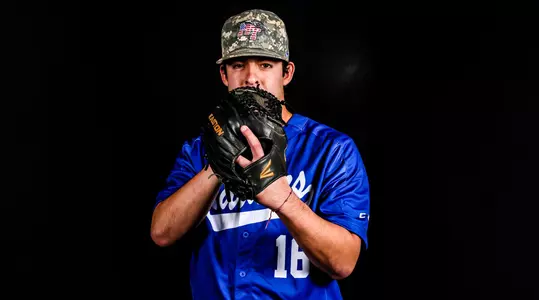
Rivera back to mound after life-threatening surgeries
3/18/2019 5:00:00 PM | Baseball
Murfreesboro, Tenn. — It was a chilly, mid-February morning in Murfreesboro, Tennessee. Middle Tennessee was preparing for just its second game of the 2018 season. With a chance to win the season-opening series, a 21-year-old right-hander calmly headed toward the dugout after he finished his warmup tosses in the bullpen.
Andy Rivera didn't have to wait any longer. His family watched intently from their seats as he finally took the mound for the first time in a Division I game. After allowing a leadoff single, Rivera sat the next three hitters in a row down on strikes to close out the opening inning of his MTSU career.
"I remember it like it was yesterday," Rivera said. "After I finished warming up, I had a lot of confidence in me. I wasn't trying to do too much. I just wanted to lay it in the zone and trust the defense."
After meeting his pitch count with two outs in the fourth, Rivera had amassed seven strikeouts and allowed two runs in an impressive debut that led to a Blue Raider win. It was a promising start to what looked to be a promising season for the fireballer from Florida.
"I started feeling some weakness"
Just days after Rivera's debut, the Blue Raiders headed down to the University of Alabama for a mid-week clash with the Crimson Tide.
A couple of hours before the game, Rivera stepped into the outfield for one of his regular daily throwing sessions. His glove popped when he received the ball, he dropped it into his right hand and threw it – nothing irregular. But, a sharp pain ran down his arm from the top of his shoulder to the tips of his fingers.
Not thinking much of it, he threw again. There it was again, that annoying sting running down his arm.
"I started feeling some weakness," Rivera said. "I was sweating and it was maybe only 50 degrees. I started throwing and couldn't even finish it."
With sweat pouring down his brow, Rivera couldn't throw the ball with the regular over-the-top motion baseball players are taught as early as t-ball. The best he could do while fighting the pain was a three-quarter arm slot. Unsure of what was wrong, Rivera and MTSU trainer Keita Isaji decided it was best for the right-hander to take a few days off before his next scheduled start.
Come that Saturday, Rivera took the mound to face Indiana State. Sweat was coming down from his hat and he hadn't even fired the game's first pitch yet.
As he stared down at catcher Jake Hagenow to get the sign, his normally tan-colored face was ghost white. Rivera kicked his left leg toward the sky and hurled a mid-80's fastball to Indiana State leadoff-man Clay Dungan that missed for ball one. There it was again, that same piercing-physical sensation trickled down his right arm.
He removed his cap and wiped his brow, stepped back onto the rubber and delivered the second pitch: ball two. What Rivera couldn't see was his arm looking like a pool noodle flailing in the air after the throw.
He fought through the pain like a boxer heading into the final round of a street brawl, but finally bowed out after four at-bats, loading the bases in the process.
"I felt pale and week," Rivera said. "I was drained, and I knew I was just off. When I got pulled (from the game), I looked at my hand as I sat in the dugout and asked myself 'What's going on?'
"I thought my baseball career was over."
Rivera headed to the hospital following the game. After performing both an ultrasound and an MRI, doctors told Rivera at almost 1 a.m. that they couldn't pinpoint exactly what was going on. They were able to tell him that either an artery wasn't getting the right amount of blood flow or that one had been cut. Without the technology to tell for sure, he'd have to go to Vanderbilt University Medical Center in Nashville.
"At that point, I started getting goosebumps and I could remember shaking," Rivera said. "I was in complete shock."
Back in Florida, Andy's mother, father and brother, Oscar, weren't 100-percent aware of everything that was going on. Prior to heading to the hospital, Rivera had spoken with his father about the symptoms, but it was Oscar that he called at 1 a.m. to deliver the grim news.
"When (Andy) called me, he was pretty freaked out," Oscar said. "When I first heard about what happened, I thought his season was done. After we hung up the phone, I was like, 'That's it, he's not going to be able to play anymore.'"
When Andy received the official diagnosis, it sounded like he may never throw another pitch ever again. The doctors told him he had thoracic outlet syndrome.
As defined by the Mayo Clinic, thoracic outlet syndrome is a condition in which blood vessels or nerves in the space between your collarbone and your first rib are compressed. The compression caused a blood clot in Rivera's right shoulder that rendered his arm nearly useless. Because it had gotten so bad, he had to undergo surgery almost immediately.
"I owe him everything"
During surgery, doctors removed one of Rivera's scalene muscles that had swollen due to the clot and were able to suck the clot out.
In the early morning hours following his surgery, Isaji looked to Rivera and told him, "Your mom is pulling into the parking lot right now." As soon as Rivera saw his mother, Mayra, he gave her a hug.
"I was crying and didn't know what to do," Rivera said. "I thought my world had ended. Baseball has always been my life. It's funny when people say 'baseball is life', but for me it literally is."
Even though he'd just had surgery to remove the numbing pain from his arm, a wave of numbness crashed over his body. The 21 year old had some huge decisions to make in the upcoming summer months.
After classes let out in May, Rivera returned home to Miami for the summer along with his brother, Oscar, who finished up the semester at FIU. It was in Miami on the same ballfields that Rivera grew up on that he realized he wasn't quite done chasing his dreams.
Every day as the sun was rising, the alarm next to Rivera's bed screeched at him to get up. After quickly jumping out of bed, it was off to get a quick workout in. Then, he met the one guy who knew him best on the baseball field to begin his daily throwing sessions.
Oscar slid the catcher's mitt onto his left hand and squatted behind the plate in the fenced-off bullpen. Rivera took his first few steps onto the hill, ready to test if the strength was coming back in his arm.
He gripped the ball as it sat in his glove and began his windup. Oscar didn't even have to move his glove as the pitch went right down the middle. Sure, it wasn't the typical 92 mph fastball he was used to throwing, but it was progress, and even more importantly, he was playing catch with his big brother again, just like when they grew up.
A former college pitcher himself, Oscar Rivera gave up the game he loved so the Riveras could financially support Andy continuing his baseball career.
As an older brother, Oscar's sacrificed a lot to see his younger brother succeed. When he got the phone call on that fateful day in February, there was no way he was going to let Andy give up on his dream of playing ball.
"I was proud to see how hard (Andy) worked as an older brother," Oscar Rivera said. "I told him when he got home for the summer, it's time to go to work. You're going to bust your butt and get back to it. You're going to get on the mound again."
When it was time for Andy Rivera to head back to Murfreesboro, his older brother followed so he would have someone to catch his bullpen sessions before the other players came back to town.
Pitch after pitch, smile after smile, laugh after laugh, the long and strenuous summer was coming to a close. Just like when they played together as kids, Rivera was pitching to his brother without a care in the world. The only thing that mattered was a 10-inch pile of dirt and a white ball sewn together with 108 stitches. The longest summer of the brothers' lives was finally coming to a close, and it was time again to go their separate ways.
"When (Oscar) left for the summer, it was emotional," Rivera said. "He was there from the beginning. I owe him everything."
With his brother gone, Rivera put his head down and kept working. The fastballs he was throwing at the beginning of the summer had turned back into the 90 mph gas he was accustomed to hurling as he headed into fall ball. It appeared the strenuous early-morning weight training and days spent under the hot sun with his brother were paying off.
"It's happening again"
It was finally time to put his arm to the test on Sept. 27, 2018. After waiting all summer, Rivera's chance to finally face another team had come. What was just a fall scrimmage game against a community college to all eight other guys on the diamond felt like game seven of the World Series to the one the mound.
The redshirt junior breezed through the Columbia State Community College lineup in a couple of innings of work, the familiar zip coursing through his arm and down to his fingertips on every pitch. Rivera's world was beginning to rotate again.
Then, as if he'd entered the movie "Groundhog Day", Rivera's worst fear came rearing its ugly head again a week later in a scrimmage against Motlow State.
Sweat ran down the back of his neck as he walked to the dugout. His face began to turn that same off-white color it had done before. Something was wrong.
Rivera sat down with his eyes closed and his hand over his eyes. When he finally took his hand away and opened his eyes, he stared down at his right index finger. What he saw was the exact same thing he saw earlier that spring: the stark-white color running down his arm and onto his hand.
Rivera turned to show Isaji what he was seeing.
"Oh no," the trainer muttered. "It's happening again."
"This isn't right; we've gotta go," Rivera replied.
Again, they headed to St. Thomas in Murfreesboro. This time, they were able to see what was wrong in an ultrasound. It was another blood clot that was just as big as the first a few months prior.
"When I saw it, I told myself 'now I'm for real done (with baseball),'" Rivera said. "I'm not going to be able to come back from this a second time."
He picked up his phone and dialed his brother's number. Back in Florida, Oscar was just getting ready for school. He hadn't even had the chance to grab his keys and walk out the door to start his truck when his phone began to ring.
"Hello?" Oscar asked.
"Dude," Rivera replied through tears, "I'm getting surgery again."
"What?" Oscar replied shockingly.
"I'm getting surgery again," Rivera said. "They diagnosed me with T.O.S."
After the end of the phone call, Rivera's brother's face on the other end of the line turned just as white as Rivera's when he was sitting in the dugout. Oscar thought to himself, "He's done. It's over. That's it."
And for the second time, Rivera underwent surgery to remove a blood clot in his right shoulder on Oct., 5, 2018.
"They may not know it, but I'm going to be saying, 'Thank you,' to them"
Rivera woke up to see his mother after surgery. He smiled as wide as he could while on anesthesia and hugged her, then asked a simple question: "Why is this happening to me?"
"Your grandma always used to tell me, 'Don't ask why,'" Mayra Rivera said. "Ask God what. Ask him, 'What is this preparing me for?'"
For Rivera, his mother's words changed his entire outlook as quickly as a pitch would leave his hand and smack into a catcher's mitt. Good thing, too, because he described the rehab as "100-times harder" the second go around.
On the morning of Dec. 4, 2018, less than two months after his second surgery to remove a blood clot caused by another bout with T.O.S., Rivera was in the clubhouse with a glove on his left hand and a headband wrapped around his head. His arm looked like a flailing pool noodle again when he threw, but this time he was smiling as he played catch with Isaji.
He was once again throwing a baseball. Slowly but surely, Rivera's world was spinning again.
"I wasn't supposed to start throwing for another week or two after that day (in the clubhouse)," Rivera said. "It was maybe just 10 throws at 45 (mph), but it was a start."
Just after the start of this season, Rivera advanced to throwing from the mound and in bullpen sessions regularly. The zip once again was coming back.
The dark days when he felt like his entire life had collapsed upon him and that there was nobody that could help him were becoming a thing of the past. After all the nights with his mom in the hospital and all the days working with his brother and Keita, Rivera finally felt on the verge of beating his condition not once, but twice.
"Without my parents, brother and God, I couldn't have done this," he said. "Also, Keita. I can remember during the second rehab, there were things I couldn't do at 100 percent. He told me that everything was going to be ok and that we were going to do things day by day.
"There were times when I'd tell my mom and brother that I didn't want to do this again. I was pushing everyone away. What makes them so special is that as many times as I'd push them away, they'd come back with even more love and more care."
When the Blue Raiders get ready to play this week, Rivera will be available to pitch in an actual game for the first time since last February.
Whenever his number is called, his mother, father and brother will be there to see him trot out of the bullpen. For Oscar, the tragic happenings of the past year have given him a chance to grow closer with his younger brother than ever before.
"Andy and I have gotten so much closer since his last surgery," Oscar said. "(The injuries) brought us so much closer not just in the game of baseball, but personally. After his first surgery when he dropped me off at the airport, he called Mom and told her he didn't think he was ready (to play) and she told him, 'You are ready, you just think you aren't because your brother is leaving,' so I think it's 100 percent brought us closer."
Rivera hasn't had the chance to pitch in front of his family since his first collegiate start against Western Illinois last season. No matter what happens this time, he'll be able to look up into the seats and know that the ones who willed him through the grueling and dark days without the game he loves so dearly will be smiling down on him.
"I try to picture (taking the mound again) every single day," he said. "I'm going to look at Keita and my parents and brother and best friend and smile. They may not know it, but I'm going to be saying thank you to them."
That smile will quickly turn into a menacing glare toward home plate as Rivera will once again kick his left leg toward the sky and let it rip. And he'll already be a winner when he does.
Anthony Fiorella is a student writer for goblueraiders.com. Follow him on Twitter @a_fiorella74 and also follow @MTAthletics for more on the Blue Raiders.