Middle Tennessee State University Athletics
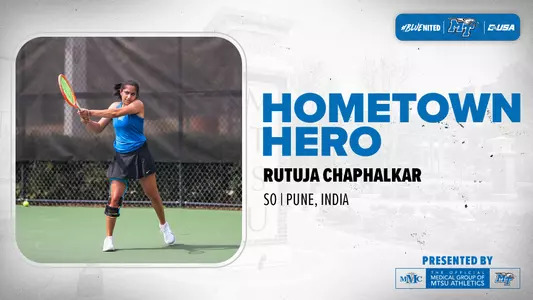
Hometown Hero: Rutuja Chaphalkar of Pune, India
1/24/2024 5:00:00 PM | Women's Tennis
MURFREESBORO, Tenn. — Fans often overlook that some of their favorite college sports stars are just as busy off the court or field with their own field of study as they are trying to succeed on it. The term "student-athlete," is used often when referring to someone who plays college sports, but it's very few and far between that the everyday person really stops to think what all embodies that term.
Rutuja Chaphalkar, a sophomore on the women's tennis team at MTSU, grew up in Pune, India, a city in the Indian State of Maharashtra. Maharashtra is one of the oldest and most established areas of the country when it comes to culture and roots. It has its own unique way of doing things and has its own set of values that everyone tries their best to uphold. Chief among those values is education, more-so the importance of practicing what you've learned and striving to always learn more. Whether it's on the court or in the classroom, it's the one value that's really defined Chaphalkar's career. It's a value instilled in her by her mother, Rohini, who took it from their family that came down the line in Pune.
"Originally, I was actually born in Florida," Chaphalkar said. "My parents moved us back to India when I was three years old, however, because they really wanted me to experience where my family was from and be in touch with my roots and culture."
Punekar is the word specifically used to identify someone that is not only from Pune, but that really embraces its culture. Rohini Chaphalkar is to Punekar just like her daughter is to student-athlete. She is a very philosophical person, someone who loves to teach and make things in life practical. If you were to ask people around town what Punekar means to them, you'd likely hear something like this: someone into literature, philosophy and history. It's someone who places importance in family, whether it's cousins, grandparents, or especially immediate family.
"My mom is the ideal Punekar," Chaphalkar said. "She is so proud of that part of her culture, and I love that part of my family. We love to practice the old traditions and we take a lot of pride in our town's history. My mom is always teaching me things. For example, one thing is that India is known for is our close-knit families. I talk to my grandparents at least once every two weeks. It makes me feel good to know it brightens their day. I just love the qualities that my mom has instilled in me that come from our culture."
Those qualities translate directly into being a student-athlete at the Division I level. Continually practicing what you've already learned translates to success both on and off the court. The mental aspect of juggling both classes and athletics is something that can easily weigh on an international player who is coming to America for the first time since she was three years old.
When it comes to tennis, taking things from life and looking at them from a practical standpoint has helped her a lot. She used to go to a sports psychologist to get different techniques to help her focus on the task at hand.
"My psychologist used to light a candle and tell me to focus on the blue part of the flame near the base instead of the orange part," Chaphalkar said. "She would have me stare at it for five minutes to see how much I could concentrate. I used to think it was odd, but when I talked to my mom about it, she told me these practices have already been in our religion and culture for so long, not just in sports."
In Pune, there's a tradition where they light a candle and pray and sing hymns. Chaphalkar's mom used to try and really focus on that time because it's something she loved. It taught Chaphalkar to focus and give her all to what she loves. It's something that really stuck with her and even now is something that she uses to help her in tough matches to calm down.
"My mom actually has recorded these religious songs with her own voice, and I still listen to them every night to help me sleep," Chaphalkar said. "If I'm feeling low, I listen to them, and they really help me keep focused on whatever I need to get done."
From an educational aspect, the continuous learning has helped her get better as time passes. Not only is she learning more about life and American culture, but drawing from that importance on education she had growing up has helped her on the court.
During a recent Sunday team meeting, Middle Tennessee Head Coach Tayo Bailey-Duvall asked the team what motivated them to get up at 5:00 a.m. for a 6:00 weightlifting session and do the same things repeatedly?
"My answer was that I do it because everything I'm doing is so important in the big picture," Chaphalkar said. "My mom taught me to always be open to not only learning but continuing to practice things that you've previously learned. Practice makes perfect, and even if we're doing something that we always do in practice, the only way to get better at it is to continue doing it, and along the way you can pick up on new things."
When MTSU first reached out to Chaphalkar, she was excited. She always had an idea of going to America and it's proven to be important for her tennis career.
She wasn't always sold on the tennis part, though. In India, there's a notion that playing college tennis is taking away from time spent playing professionally because you are working on a degree instead of just playing tennis.
Because of Covid-19, it opened her eyes to the importance of a degree in case tennis doesn't work out long-term. The best part about college tennis to her is that she can earn a degree and play tennis at a high level. It gives you options and more opportunities. She chose a major in something that she loves: fine arts. She loves art, and it helps her escape from some of the things that can cause stress in life.
"I love having the chance to study fine arts and play tennis because they are two things that I like to dedicate my time to," Chaphalkar said. "I have to really spend a lot of time making sure I practice tennis, too, because of my studies, but I haven't struggled at all with it mentally because I love doing both so much."
Last season as a freshman, Chaphalkar suffered a knee injury in February and missed the rest of the season. Learning to be open to new experiences and ideas from her time growing up in Pune really helped her deal with the rehabilitation process not only physically, but mentally. Now almost a year removed from the injury, she's gotten off to a good start as she's helped the Blue Raiders to a 2-1 start that includes wins over Chattanooga and a come-from-behind effort against Conference USA foe Jacksonville State.
"I was very set on what I wanted my four years (at MTSU) to be like but because of the injury, it changed everything," Chaphalkar said. "I had to start over, and it all hit me at once. I didn't know if I'd get back to the level I was at before the injury. Remaining set in being open to help and learning how to get through it, I knew I could do it and now I have gotten through it. I was in a lot of pain, but it showed if I could get through this, I could get through anything. You're always stronger than you think you are. I've come back and feel honestly, better than before the injury."
Off the court, Chaphalkar tried hard as an international student to fit in to the American lifestyle. She feels like from the get-go she was able to do that. She changed her fashion-sense and the way she talks some to try to fit in and did, but then quickly realized that she didn't have to do that. She could be the same adventurous and eager young woman she grew up to become in Pune and still be successful here.
"When I first got here, I tried to change so much and quickly realized that I don't need to," Chaphalkar said. "I'm proud to be Indian and am proud when someone calls me Indian. Most of my friends here are American, and there's no social or cultural limits to our friendships. It makes me happy to know that all these years I spent with my family in Pune, I have so many people back home that I can always lean on and share everything with."
Though it's only been two short seasons, Chaphalkar's role within the team and her abilities to make a difference both on and off the court continue to evolve on a day-to-day basis. Because of the steadfast roots she has in her culture, gained from her mother, she's helped add one more description to the word Punekar; and that description is an MTSU student-athlete, a description that Pune and the Chaphalkar family can join in taking pride in for years to come.
Rutuja Chaphalkar, a sophomore on the women's tennis team at MTSU, grew up in Pune, India, a city in the Indian State of Maharashtra. Maharashtra is one of the oldest and most established areas of the country when it comes to culture and roots. It has its own unique way of doing things and has its own set of values that everyone tries their best to uphold. Chief among those values is education, more-so the importance of practicing what you've learned and striving to always learn more. Whether it's on the court or in the classroom, it's the one value that's really defined Chaphalkar's career. It's a value instilled in her by her mother, Rohini, who took it from their family that came down the line in Pune.
"Originally, I was actually born in Florida," Chaphalkar said. "My parents moved us back to India when I was three years old, however, because they really wanted me to experience where my family was from and be in touch with my roots and culture."
Punekar is the word specifically used to identify someone that is not only from Pune, but that really embraces its culture. Rohini Chaphalkar is to Punekar just like her daughter is to student-athlete. She is a very philosophical person, someone who loves to teach and make things in life practical. If you were to ask people around town what Punekar means to them, you'd likely hear something like this: someone into literature, philosophy and history. It's someone who places importance in family, whether it's cousins, grandparents, or especially immediate family.
"My mom is the ideal Punekar," Chaphalkar said. "She is so proud of that part of her culture, and I love that part of my family. We love to practice the old traditions and we take a lot of pride in our town's history. My mom is always teaching me things. For example, one thing is that India is known for is our close-knit families. I talk to my grandparents at least once every two weeks. It makes me feel good to know it brightens their day. I just love the qualities that my mom has instilled in me that come from our culture."
Those qualities translate directly into being a student-athlete at the Division I level. Continually practicing what you've already learned translates to success both on and off the court. The mental aspect of juggling both classes and athletics is something that can easily weigh on an international player who is coming to America for the first time since she was three years old.
When it comes to tennis, taking things from life and looking at them from a practical standpoint has helped her a lot. She used to go to a sports psychologist to get different techniques to help her focus on the task at hand.
"My psychologist used to light a candle and tell me to focus on the blue part of the flame near the base instead of the orange part," Chaphalkar said. "She would have me stare at it for five minutes to see how much I could concentrate. I used to think it was odd, but when I talked to my mom about it, she told me these practices have already been in our religion and culture for so long, not just in sports."
In Pune, there's a tradition where they light a candle and pray and sing hymns. Chaphalkar's mom used to try and really focus on that time because it's something she loved. It taught Chaphalkar to focus and give her all to what she loves. It's something that really stuck with her and even now is something that she uses to help her in tough matches to calm down.
"My mom actually has recorded these religious songs with her own voice, and I still listen to them every night to help me sleep," Chaphalkar said. "If I'm feeling low, I listen to them, and they really help me keep focused on whatever I need to get done."
From an educational aspect, the continuous learning has helped her get better as time passes. Not only is she learning more about life and American culture, but drawing from that importance on education she had growing up has helped her on the court.
During a recent Sunday team meeting, Middle Tennessee Head Coach Tayo Bailey-Duvall asked the team what motivated them to get up at 5:00 a.m. for a 6:00 weightlifting session and do the same things repeatedly?
"My answer was that I do it because everything I'm doing is so important in the big picture," Chaphalkar said. "My mom taught me to always be open to not only learning but continuing to practice things that you've previously learned. Practice makes perfect, and even if we're doing something that we always do in practice, the only way to get better at it is to continue doing it, and along the way you can pick up on new things."
When MTSU first reached out to Chaphalkar, she was excited. She always had an idea of going to America and it's proven to be important for her tennis career.
She wasn't always sold on the tennis part, though. In India, there's a notion that playing college tennis is taking away from time spent playing professionally because you are working on a degree instead of just playing tennis.
Because of Covid-19, it opened her eyes to the importance of a degree in case tennis doesn't work out long-term. The best part about college tennis to her is that she can earn a degree and play tennis at a high level. It gives you options and more opportunities. She chose a major in something that she loves: fine arts. She loves art, and it helps her escape from some of the things that can cause stress in life.
"I love having the chance to study fine arts and play tennis because they are two things that I like to dedicate my time to," Chaphalkar said. "I have to really spend a lot of time making sure I practice tennis, too, because of my studies, but I haven't struggled at all with it mentally because I love doing both so much."
Last season as a freshman, Chaphalkar suffered a knee injury in February and missed the rest of the season. Learning to be open to new experiences and ideas from her time growing up in Pune really helped her deal with the rehabilitation process not only physically, but mentally. Now almost a year removed from the injury, she's gotten off to a good start as she's helped the Blue Raiders to a 2-1 start that includes wins over Chattanooga and a come-from-behind effort against Conference USA foe Jacksonville State.
"I was very set on what I wanted my four years (at MTSU) to be like but because of the injury, it changed everything," Chaphalkar said. "I had to start over, and it all hit me at once. I didn't know if I'd get back to the level I was at before the injury. Remaining set in being open to help and learning how to get through it, I knew I could do it and now I have gotten through it. I was in a lot of pain, but it showed if I could get through this, I could get through anything. You're always stronger than you think you are. I've come back and feel honestly, better than before the injury."
Off the court, Chaphalkar tried hard as an international student to fit in to the American lifestyle. She feels like from the get-go she was able to do that. She changed her fashion-sense and the way she talks some to try to fit in and did, but then quickly realized that she didn't have to do that. She could be the same adventurous and eager young woman she grew up to become in Pune and still be successful here.
"When I first got here, I tried to change so much and quickly realized that I don't need to," Chaphalkar said. "I'm proud to be Indian and am proud when someone calls me Indian. Most of my friends here are American, and there's no social or cultural limits to our friendships. It makes me happy to know that all these years I spent with my family in Pune, I have so many people back home that I can always lean on and share everything with."
Though it's only been two short seasons, Chaphalkar's role within the team and her abilities to make a difference both on and off the court continue to evolve on a day-to-day basis. Because of the steadfast roots she has in her culture, gained from her mother, she's helped add one more description to the word Punekar; and that description is an MTSU student-athlete, a description that Pune and the Chaphalkar family can join in taking pride in for years to come.


Players Mentioned

/ Women's Tennis
MTSU Tennis Pro-Am 9/6/25
Tuesday, September 09
Facility tour – Stephen and Denise Smith Student-Athlete Performance Center
Wednesday, July 30
Spring Sports Show hosted by The Boulevard – April 14, 2025: Women’s Tennis and Men’s Tennis
Monday, April 14
MTSU Women's Tennis vs WKU Recap on 04/08/25
Thursday, April 10