Middle Tennessee State University Athletics
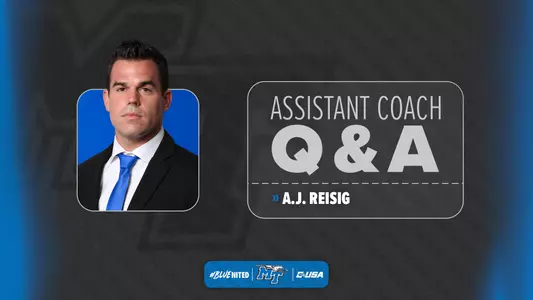
“There's a little chip on your shoulder” - Q&A with Linebacker’s Coach A.J. Reisig
3/12/2024 10:31:00 AM | Football
The new MTSU Linebackers coach has taken a Blue Collar path to Murfreesboro
MURFREESBORO, Tenn. — A.J. Reisig knows folks might not have heard of every school he's been at in his coaching career. When you finish your playing days as a Division III cornerback, your path to becoming an FBS position coach can look a little different than many of your peers. It's a lot of GA stops, lots of analyst roles and lots of long hours in the football office before anyone arrives and after everyone leaves.
But if you keep the main thing the main thing, refine your craft, and make a few connections along the way, football can take you places you never knew you needed to be. It's done that for Reisig, most notably in a pair of stints coaching at the Merchant Marine Academy, the United States' oft-forgotten service academy.
"Army, Navy, Coast Guard, Air Force, it's the fifth one, people just never hear of it because those four are Department of Defense," Reisig explained. "(The Merchant Marine Academy) is technically under the Department of Transportation. But they can go into any branch of service if they choose to. About 33 percent of them go into a military branch. If they choose not to, they become Merchant Mariners, who are driving the cargo ships, power plants on shore, driving ferries, stuff like that.
"It gives you a little bit more respect and admiration for those guys that do it for our country and do it for football," Reisig said. "Some of these kids don't understand how tough that can be. Going to a military school and playing football? I don't care where you're at, that's tough."
Reisig first coached the Mariners his first year out of Dickinson, but made his way back to Kings Point, N.Y. in 2020, after being furloughed from Towson due to the COVID-19 pandemic. His old boss, Coach Mike Toop, needed help on the defensive line for the one game on the Mariners' schedule that year: the annual Secretaries Cup against the other D-III service academy, the Coast Guard.
Reisig jumped at the chance, even teaching classes on aquatic survival to the academy's midshipmen, with campus shutdown so that athletics could happen that fall.
"We practiced all season long for that Coast Guard game," Reisig said. "It was awesome to go out there. The seniors, they deserved it."
The Mariners would be victorious, defeating the Coast Guard Bears 35-14 in 2020. Reisig would then reconnect with an old mentor, Brian Stewart, when Stewart came back to Maryland for the second time and brought Reisig with him for his own second stint. And after following Stewart to the XFL with the Houston Roughnecks, Reisig is now with Stewart in Murfreesboro to run the linebacker room for the Blue Raiders.
"I always leaned on him for advice," Reisig said of his connection with Stewart. "He became like a mentor to me. But it's one of those things where it's grown a little more. No. 1, he's my boss but No. 2, he's a mentor, a friend. I know I can count on him for anything. It was a good connection to make."
Reisig recently sat down with GoBlueRaiders.com staff writer Sam Doughton to chat about getting into coaching after Division III football, making connections, coaching in the XFL and his thoughts on working with the Blue Raider linebacker room so far.
The conversation has been edited and condensed for space and clarity.
--
You started your coaching career at the Division III level, where you also played your college ball. You've had to grind your way up the coaching ranks to get to where you're at. What are some of the lessons you learned as a D-III athlete that you apply to who you are today?
You always had to learn how to do it with not many resources. You take on a lot of jobs. But when it's all said and done, football is football. Regardless of what level you are, we're all doing the same thing. We're all teaching the fundamentals, techniques and all that stuff. For me, it was just getting the chance to coach.
I always knew I wanted to coach. My dad coached youth league football. I joke around, I was the quarterback of the family. I have two older brothers who also played, so I always felt like my dad liked me a little bit more. He played quarterback, I played quarterback. At Dickinson, I knew I wanted to get into coaching, our defensive coordinator kind of brought me in once I was done. I helped out in the spring.
I went home for the summer. I was kind of contemplating what I was going to do, then I got a call from the Merchant Marine Academy. We used to play them, and I think their head coach kind of called around. They needed a kind of young guy. I showed up, they were already two days into practice. I was kind of thrown into the fire there.
Throughout my time, there's a little chip on your shoulder. Because you know some of the guys growing up, I always wondered, "Hey, how'd you get that job?" You realize it has a lot to do with connections. Well, I didn't have any connections. So, it was for me just being good at my craft, coaching, and working through what I felt comfortable building connections. But for the players, I don't coach any differently whether I was at D-III, XFL, FBS, it's all the same to me. You've got to teach them hard, coach them hard, love them up a little bit. But in the end, it's all about Xs and Os, good fundamentals and good techniques.
You mention making connections to keep advancing in the coaching world. One connection you've clearly made is Brian Stewart. How did y'all meet in the first place and how have y'all clearly kept that bond for so long?
In 2011 and 12, I was at Shippensburg University. We had some good runs and Coach Mike Yurcich is the offensive coordinator that went from Shippensburg University to Oklahoma State. That was the first thing, everyone was like "What? From Division II to FBS?" That kind of put Shippensburg on the map a little bit. Coach Mark Maciejewski, he's done a great job.
But after Mike Gundy hired Yurcich, I started putting a few feelers out there for schools that were at least in the area that I might have known some people. Coach Greg Gattuso, he's now the head coach at Albany (was the D-Line coach at Maryland at the time), he had recruited my brother out of high school. One of my brother's good friends, Yardon Brantley, he was a receiver, ended up playing for (Gattuso) at Duquesne. So, I kind of had at least a starting conversation, an ice breaker.
I reached out to Greg, interviewed with him down at the AFCA convention in Nashville and he brought me down. I met Coach Stewart in 2013 and then I worked with him in the secondary. He was awesome to work for, because he truly believes in giving young coaches a chance. At practices, he would take the corners, I would take the safeties, and I was like a position coach working with the safeties. That was good experience to get.
We were there for two years. It just kind of clicked between us. When you're working in the secondary, it was us always together. As he's the playcaller and I'm his GA, I'm not leaving until he's leaving! So we did late nights together, we'd get food together. Once he left for Nebraska, we just always stayed in touch. If you really think about it, from 2015 to 2021, we didn't work together. It just goes to show you that we kept that connection. We'd always call, we'd check on each other.
I always leaned on him for advice. He became like a mentor to me. But it's one of those things where it's grown a little more. No. 1, he's my boss but No. 2, he's a mentor, a friend. I know I can count on him for anything. It was a good connection to make.
What was breaking into the professional ranks of coaching with Coach Stewart in the XFL like?
I had just finished my second season at Maryland, we had just finished a bowl game. I didn't know what was happening. Then, Coach Stewart called me about the opportunity to coach linebackers with him and Coach Wade Phillips. Now, I trust Coach Stewart, so if he says this is a good opportunity, I'm going to trust him. And anytime you get to work with Coach Wade is incredible.
It was fun. Like Coach Stewart said, that's probably the most fun I had coaching. You had kids there; it was almost their second chance. They had all their college stuff, they thought they were going to the pros. This was some of their second chances and some of them, it was their last chance. It was awesome to see the energy and the passion that these dudes came out with every day.
I think why we succeeded so well on defense was just because of how close they were. As Coach Mason says here, "coaches fed, players led." We're going to give you everything that you need to do, now just go out there and do it. That's kind of how that group was and I think that's why we were so successful, because they all wanted to be there. They all became friends. We didn't have to keep tabs on them. That's the biggest difference between professionals and college. Here, they've got school, graduate, go to class, and there's more distractions. With the XFL, most of those dudes left their families and they were living out of a hotel room for four months. So, there wasn't as many distractions.
In college, that's one thing. Making sure that here, we're keeping the guys in tune to when we're on the grass, we're on the grass. When we're in meeting rooms, we're in meeting rooms. As Coach Stewart always says, be where your feet are. Wherever your feet are, be in that moment. I know there's a lot of things going on outside of this practice field or this meeting room, but let's handle it when that comes. Be in the moment, live in the moment and let those things take care of themselves.
Any coaching change obviously brings with it some scheme change, though y'all still have much to figure out on the grass this spring on what that scheme might look like. How are you preparing the linebackers right now for that transition?
For us, it's "same as" teaching. Whether the defense changes from what our structure is, whether it's a 3-4, over, under, a G-front, 4-2-5, whatever it may be. We're in quarters, we're in cover two, we're in cover three, whatever it is, "same as". We're giving them the tools that they can use in whatever structure it may be. So, the structure may change, the calls may change, but the techniques, the schemes, everything like that, is the same. So, we're not over complicating.
We might give you ten defenses, but you already have the tools to play those ten defenses. I think that's where in spring ball we'll be good. Getting to those guys to understand all the tools that they have and how it can translate into all of the schemes and structures.
You've come into a crowded linebacker room, one where a lot of guys played a season ago. What have you liked about your group as you've gotten to know them and watched them on film?
We've got some long, big guys. Parker Hughes, he ended up with one of the faster 40s on the team. You've got a big guy moving that fast, you always love that. Right now, I just love their attention to detail and their energy in the meeting room, on walkthroughs, some of the early morning runs.
We're all going to make mistakes. But if you have good energy and you're willing to learn, I can work with that. Anyone would be willing to go out of their way to help a kid that's attacking it with the right mindset. Right now, I love the mindset we have as players.
But if you keep the main thing the main thing, refine your craft, and make a few connections along the way, football can take you places you never knew you needed to be. It's done that for Reisig, most notably in a pair of stints coaching at the Merchant Marine Academy, the United States' oft-forgotten service academy.
"Army, Navy, Coast Guard, Air Force, it's the fifth one, people just never hear of it because those four are Department of Defense," Reisig explained. "(The Merchant Marine Academy) is technically under the Department of Transportation. But they can go into any branch of service if they choose to. About 33 percent of them go into a military branch. If they choose not to, they become Merchant Mariners, who are driving the cargo ships, power plants on shore, driving ferries, stuff like that.
"It gives you a little bit more respect and admiration for those guys that do it for our country and do it for football," Reisig said. "Some of these kids don't understand how tough that can be. Going to a military school and playing football? I don't care where you're at, that's tough."
Reisig first coached the Mariners his first year out of Dickinson, but made his way back to Kings Point, N.Y. in 2020, after being furloughed from Towson due to the COVID-19 pandemic. His old boss, Coach Mike Toop, needed help on the defensive line for the one game on the Mariners' schedule that year: the annual Secretaries Cup against the other D-III service academy, the Coast Guard.
Reisig jumped at the chance, even teaching classes on aquatic survival to the academy's midshipmen, with campus shutdown so that athletics could happen that fall.
"We practiced all season long for that Coast Guard game," Reisig said. "It was awesome to go out there. The seniors, they deserved it."
The Mariners would be victorious, defeating the Coast Guard Bears 35-14 in 2020. Reisig would then reconnect with an old mentor, Brian Stewart, when Stewart came back to Maryland for the second time and brought Reisig with him for his own second stint. And after following Stewart to the XFL with the Houston Roughnecks, Reisig is now with Stewart in Murfreesboro to run the linebacker room for the Blue Raiders.
"I always leaned on him for advice," Reisig said of his connection with Stewart. "He became like a mentor to me. But it's one of those things where it's grown a little more. No. 1, he's my boss but No. 2, he's a mentor, a friend. I know I can count on him for anything. It was a good connection to make."
Reisig recently sat down with GoBlueRaiders.com staff writer Sam Doughton to chat about getting into coaching after Division III football, making connections, coaching in the XFL and his thoughts on working with the Blue Raider linebacker room so far.
The conversation has been edited and condensed for space and clarity.
--
You started your coaching career at the Division III level, where you also played your college ball. You've had to grind your way up the coaching ranks to get to where you're at. What are some of the lessons you learned as a D-III athlete that you apply to who you are today?
You always had to learn how to do it with not many resources. You take on a lot of jobs. But when it's all said and done, football is football. Regardless of what level you are, we're all doing the same thing. We're all teaching the fundamentals, techniques and all that stuff. For me, it was just getting the chance to coach.
I always knew I wanted to coach. My dad coached youth league football. I joke around, I was the quarterback of the family. I have two older brothers who also played, so I always felt like my dad liked me a little bit more. He played quarterback, I played quarterback. At Dickinson, I knew I wanted to get into coaching, our defensive coordinator kind of brought me in once I was done. I helped out in the spring.
I went home for the summer. I was kind of contemplating what I was going to do, then I got a call from the Merchant Marine Academy. We used to play them, and I think their head coach kind of called around. They needed a kind of young guy. I showed up, they were already two days into practice. I was kind of thrown into the fire there.
Throughout my time, there's a little chip on your shoulder. Because you know some of the guys growing up, I always wondered, "Hey, how'd you get that job?" You realize it has a lot to do with connections. Well, I didn't have any connections. So, it was for me just being good at my craft, coaching, and working through what I felt comfortable building connections. But for the players, I don't coach any differently whether I was at D-III, XFL, FBS, it's all the same to me. You've got to teach them hard, coach them hard, love them up a little bit. But in the end, it's all about Xs and Os, good fundamentals and good techniques.
You mention making connections to keep advancing in the coaching world. One connection you've clearly made is Brian Stewart. How did y'all meet in the first place and how have y'all clearly kept that bond for so long?
In 2011 and 12, I was at Shippensburg University. We had some good runs and Coach Mike Yurcich is the offensive coordinator that went from Shippensburg University to Oklahoma State. That was the first thing, everyone was like "What? From Division II to FBS?" That kind of put Shippensburg on the map a little bit. Coach Mark Maciejewski, he's done a great job.
But after Mike Gundy hired Yurcich, I started putting a few feelers out there for schools that were at least in the area that I might have known some people. Coach Greg Gattuso, he's now the head coach at Albany (was the D-Line coach at Maryland at the time), he had recruited my brother out of high school. One of my brother's good friends, Yardon Brantley, he was a receiver, ended up playing for (Gattuso) at Duquesne. So, I kind of had at least a starting conversation, an ice breaker.
I reached out to Greg, interviewed with him down at the AFCA convention in Nashville and he brought me down. I met Coach Stewart in 2013 and then I worked with him in the secondary. He was awesome to work for, because he truly believes in giving young coaches a chance. At practices, he would take the corners, I would take the safeties, and I was like a position coach working with the safeties. That was good experience to get.
We were there for two years. It just kind of clicked between us. When you're working in the secondary, it was us always together. As he's the playcaller and I'm his GA, I'm not leaving until he's leaving! So we did late nights together, we'd get food together. Once he left for Nebraska, we just always stayed in touch. If you really think about it, from 2015 to 2021, we didn't work together. It just goes to show you that we kept that connection. We'd always call, we'd check on each other.
I always leaned on him for advice. He became like a mentor to me. But it's one of those things where it's grown a little more. No. 1, he's my boss but No. 2, he's a mentor, a friend. I know I can count on him for anything. It was a good connection to make.
What was breaking into the professional ranks of coaching with Coach Stewart in the XFL like?
I had just finished my second season at Maryland, we had just finished a bowl game. I didn't know what was happening. Then, Coach Stewart called me about the opportunity to coach linebackers with him and Coach Wade Phillips. Now, I trust Coach Stewart, so if he says this is a good opportunity, I'm going to trust him. And anytime you get to work with Coach Wade is incredible.
It was fun. Like Coach Stewart said, that's probably the most fun I had coaching. You had kids there; it was almost their second chance. They had all their college stuff, they thought they were going to the pros. This was some of their second chances and some of them, it was their last chance. It was awesome to see the energy and the passion that these dudes came out with every day.
I think why we succeeded so well on defense was just because of how close they were. As Coach Mason says here, "coaches fed, players led." We're going to give you everything that you need to do, now just go out there and do it. That's kind of how that group was and I think that's why we were so successful, because they all wanted to be there. They all became friends. We didn't have to keep tabs on them. That's the biggest difference between professionals and college. Here, they've got school, graduate, go to class, and there's more distractions. With the XFL, most of those dudes left their families and they were living out of a hotel room for four months. So, there wasn't as many distractions.
In college, that's one thing. Making sure that here, we're keeping the guys in tune to when we're on the grass, we're on the grass. When we're in meeting rooms, we're in meeting rooms. As Coach Stewart always says, be where your feet are. Wherever your feet are, be in that moment. I know there's a lot of things going on outside of this practice field or this meeting room, but let's handle it when that comes. Be in the moment, live in the moment and let those things take care of themselves.
Any coaching change obviously brings with it some scheme change, though y'all still have much to figure out on the grass this spring on what that scheme might look like. How are you preparing the linebackers right now for that transition?
For us, it's "same as" teaching. Whether the defense changes from what our structure is, whether it's a 3-4, over, under, a G-front, 4-2-5, whatever it may be. We're in quarters, we're in cover two, we're in cover three, whatever it is, "same as". We're giving them the tools that they can use in whatever structure it may be. So, the structure may change, the calls may change, but the techniques, the schemes, everything like that, is the same. So, we're not over complicating.
We might give you ten defenses, but you already have the tools to play those ten defenses. I think that's where in spring ball we'll be good. Getting to those guys to understand all the tools that they have and how it can translate into all of the schemes and structures.
You've come into a crowded linebacker room, one where a lot of guys played a season ago. What have you liked about your group as you've gotten to know them and watched them on film?
We've got some long, big guys. Parker Hughes, he ended up with one of the faster 40s on the team. You've got a big guy moving that fast, you always love that. Right now, I just love their attention to detail and their energy in the meeting room, on walkthroughs, some of the early morning runs.
We're all going to make mistakes. But if you have good energy and you're willing to learn, I can work with that. Anyone would be willing to go out of their way to help a kid that's attacking it with the right mindset. Right now, I love the mindset we have as players.
Players Mentioned
LB
/ FootballMTSU Football Signing Day Press Conference 12/3/25
Wednesday, December 03
MTSU Football at New Mexico State post-game press conference – 11/29/25
Sunday, November 30
MTSU Football at New Mexico State post-game press conference – 11/29/25
Saturday, November 29
Raider Report Game 12 - MTSU vs. New Mexico State University
Friday, November 28